Stage B’s recommendation cycle appears to have entered a contracted phase. New work is receiving less exploratory distribution, and the audience appears to concentrate on recurring followers.
I ran a more detailed scoring system on this test, where we split the scoring into engagement and print potential. If you recall from the previous post, the original engagement scoring formula is:
$$ \frac{(\text{Profile Views} \times 2) + (\text{Follows} \times 5) + (\text{Likes} \times 1) + (\text{Reposts} \times 5) + (\text{Comments} \times 3)}{\text{Total Views}} $$The print potential score is similar, but does not include profile views. So we end up with a simpler version:
$$ \frac{(\text{Follows} \times 5) + (\text{Likes} \times 1) + (\text{Reposts} \times 5) + (\text{Comments} \times 3)}{\text{Total Views}} $$These weights represent how I’ve valued different responses within this game; they are not estimates of Stage B’s internal scoring. Likewise, print potential is a provisional signal rather than a prediction of sales.
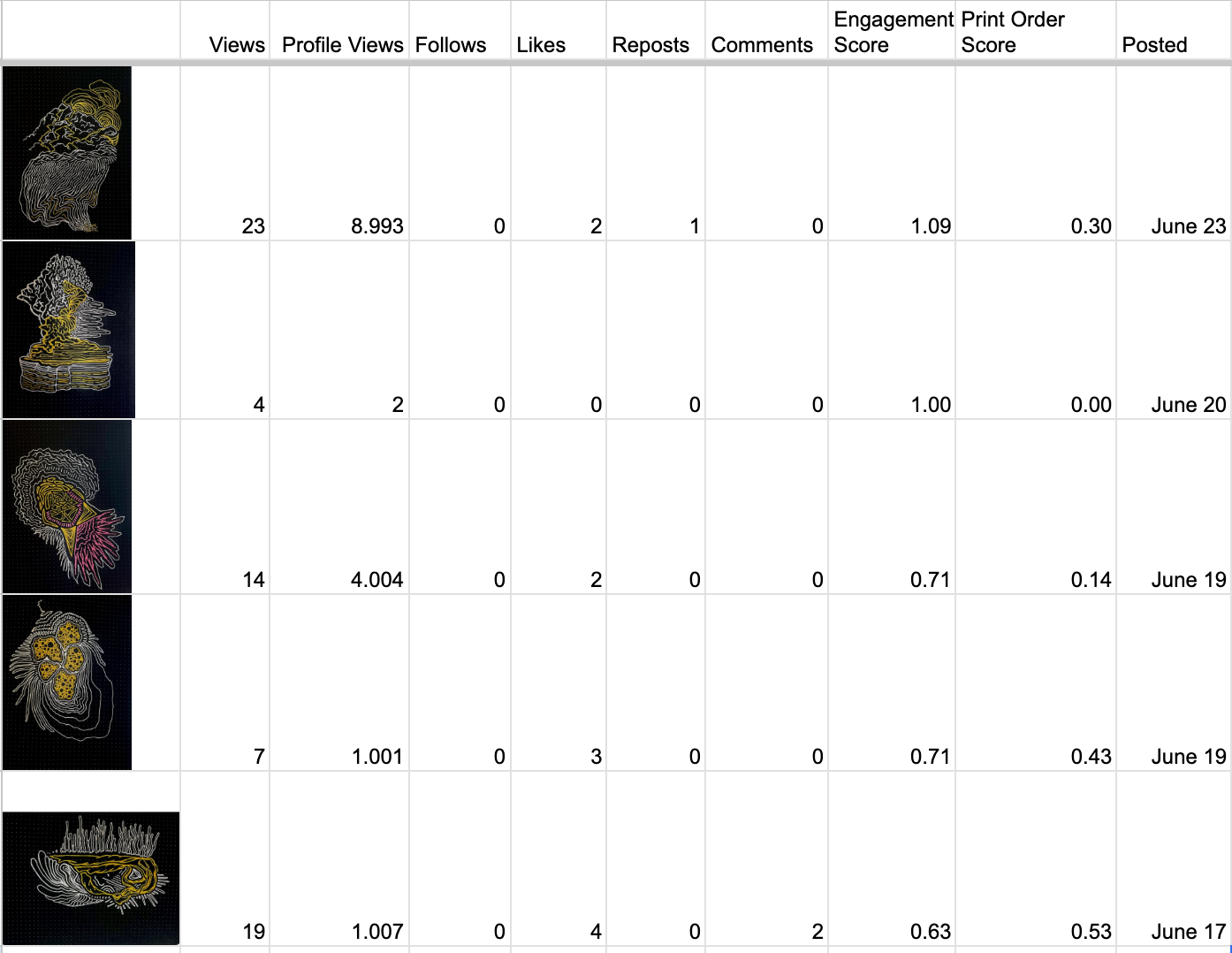
Comparing between the engagement score top five:
and the print potential score:
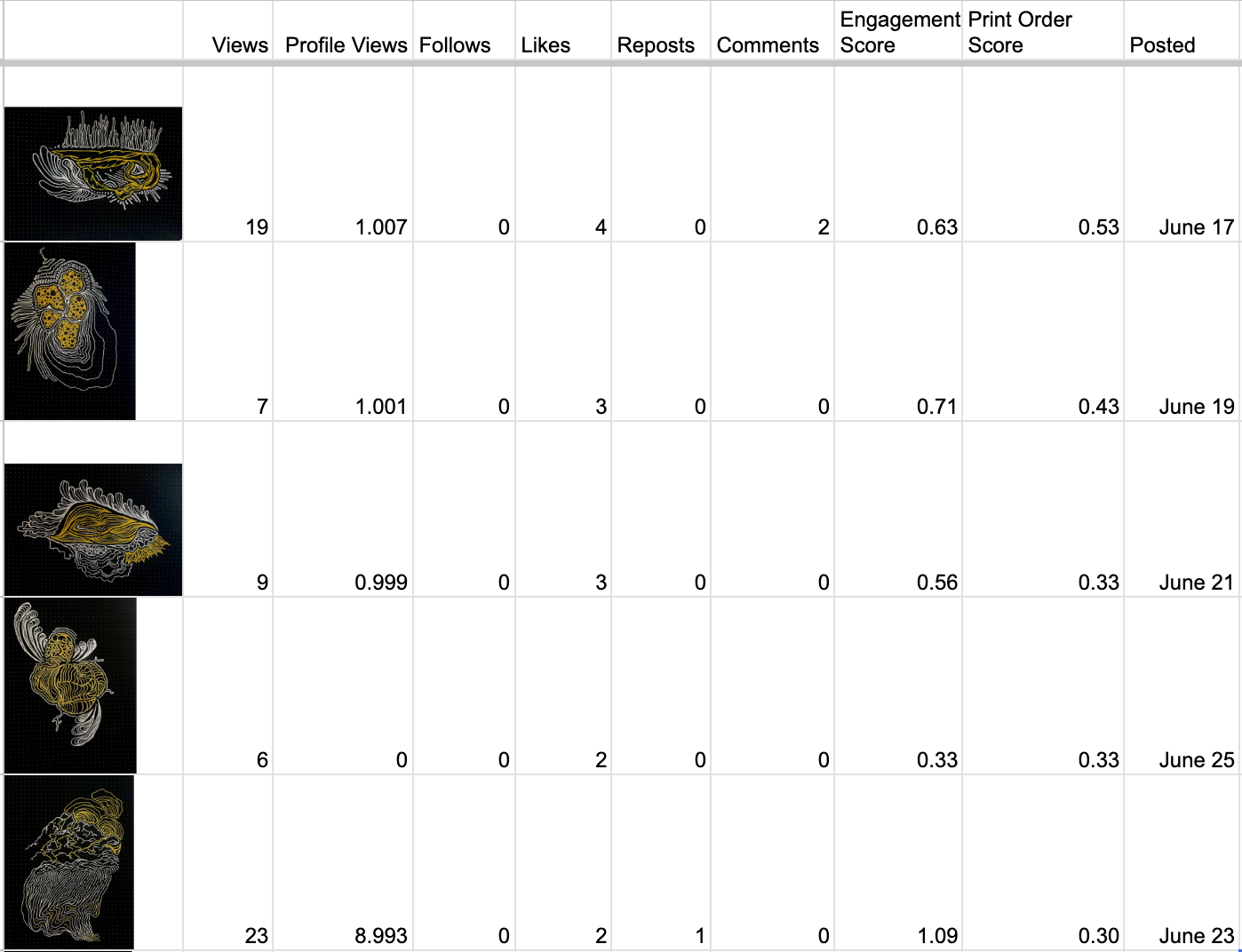
Three works appear in both the engagement and print-potential top-five rankings, after posting 40 different works between June 13 and June 25.
What did I gather from this exploration? I see the synthesis of engagement feedback and game algorithms as a feedback loop of entrained pattern matching. The stage shows the player patterns it already recognizes, while the player repeats these patterns to remain visible within the stage. Each repetition gives the stage more of what it already knows, further reducing the visibility of paths it has not traveled.
If a player is outside the short head (the more commonly trained) of patterns currently legible to the stage, their content may become trapped within a localized loop. The loop shifts when the short head shifts, or when enough players introduce a different pattern for the stage to begin recognizing it.
Entraining players to focus on short-head behavior ritualizes mimicry. The player produces what the stage recognizes, and the stage recognizes what the player has learned to produce.
At the end of this exploration, there is an irony in having started with the concept of a “clean game”: testing a newer account with a blank slate of data and content, only to make it “messy” by adding signals that could be received and returned by multiple players. The clean game could only become observable through the accumulation that made it no longer clean.