Is it art, a game or technology?
Clean games contain the presupposition that phenomenological documentation of lived pattern recognition is not about objective truth but instead about hybrid interpretations within performed frames of thinking. That is, we write subjective observations of our experiences based on our biases of experience within stages of rules that existed prior to us being aware of them. While the rules were made before we entered the stage as players, we inevitably mutate their composition by being inside of this stage.
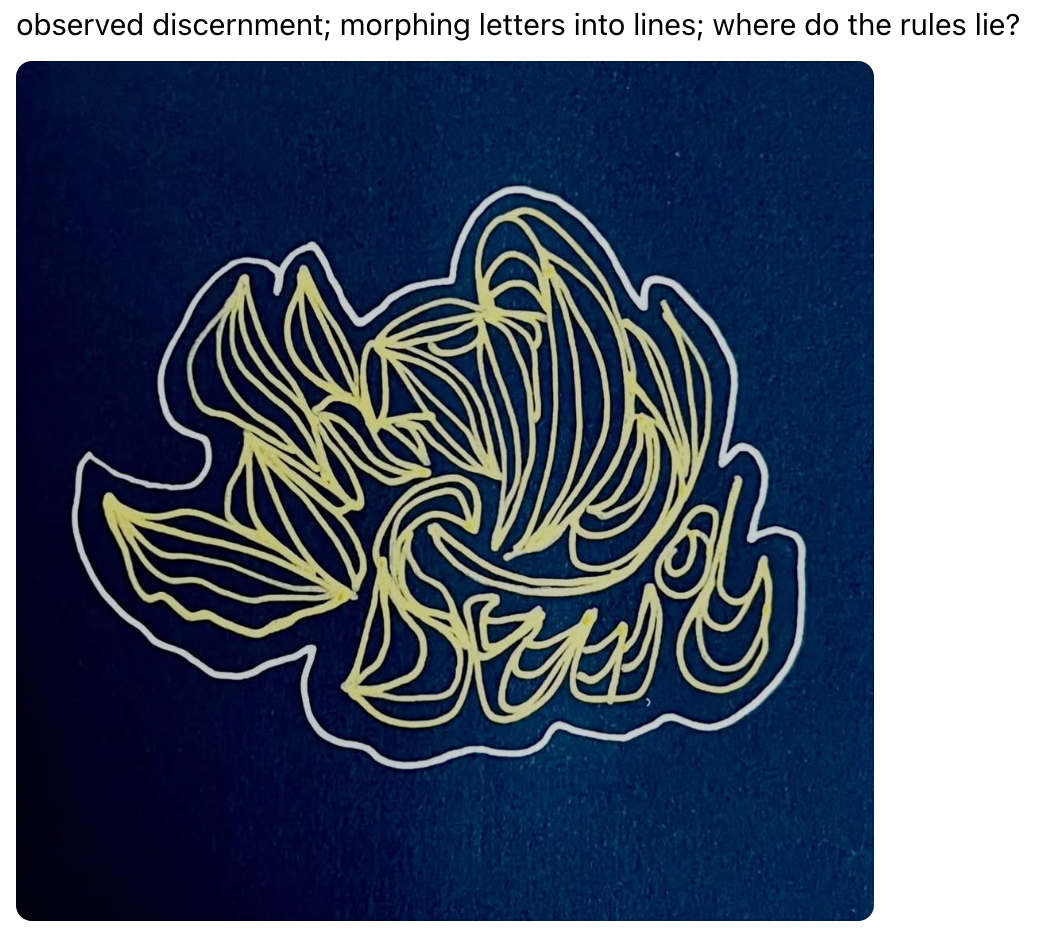
The subsequent attempt to test the OCR boundaries in our social media experiment involved a more integrated, illustrative, cursive and less obvious version of a text-within-not-text representation. This content, while masking text in a drawing, also included a haiku separated by semicolons and not line breaks. Two questions arise from this synthesis — will the text be detected and will the haiku be labeled or will it fall into the vast nothingness of a void, unable to be broadcast because the mute penalty is too high?
My initial prediction from Part 1 was mainly correct — I did get more views than I would have with the photo art with text option, but the signal was minor.
Now the strategy is to remove text in the art, re-design the art and try multiple haikus on line breaks. I’ll need to post at least a few in succession to push it towards the generalized, visually- and/or thematically-correlated feed.
Does the haiku have to relate to tagged words or tokens that other players repeat into patterns? Or does the art demand labels, assigned as trained categories in the black box stage? Or is it a combination of both depending on the re-training of the stage and the en-training of the players?
We ask again — is it art, a game or technology? Yes.