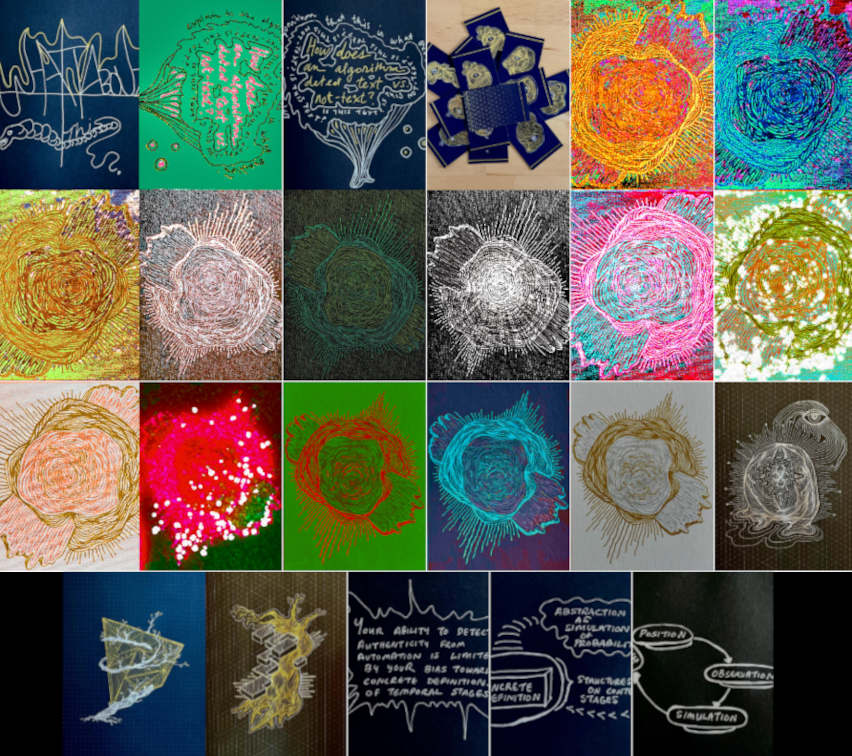
Applying clean game experiments on social media accounts (which I refer to as “stages”) is an interesting way to explore systems and their algorithms within a black box (the “stage”). Social media is a black box game stage.
What do I mean by “clean game”? I am defining it in this lens as having a somewhat newer account with very few followers in the double digits. It’s enough of a set to observe patterns of feedback loops and not enough to create additional noise that makes it difficult to discern the minimum observed rules within a stage.
I will not name the stages I have tested, as it is easy to guess and the key thing here is that it is not about the brand but the operations behind the brand. Descriptions here are what I observed as a player in these stages. My role as a player is the producer of content and also a consumer of content. Each player is also the same as my role, so we are all players of these stages through bi-directional interactions.
There are two stages I will now refer to as Stage A and Stage B. In both stages, I posted nearly identical content through varying strategies to see where they differed.
Stage A biased towards who was already following my content and generally followed with views that spread out in a pattern resembling players going to work and resuming their game play later. All content appeared to be distributed evenly to followers, which meant photo art with no text, digital art with no text, photo art with text, digital art with text.
Stage B biased towards a more generalized feed targeted via the content in itself and from my player preferences of content. In this case, Stage B differed in Stage A on content distribution. Content that contained photo art with no text and digital art with no text had a higher likelihood of receiving engagement from other players while photo art with text and digital art with text had a lower likelihood of receiving any engagement.
As a deeper strategy, I made a more organic variant of the text in illustration, where the text becomes part of the curvature and line work of the art, intermixing with a drawing of a snake and flames. Stage B also appears to bias towards actual text in the same if not higher position of photo art with no text. So I also added text with the “illustration” to merge two categories even further. Yes, I am sure the OCR can tell what it says, despite its illustrative transformation but where does it decide to penalize?
While I wait for the data, I will first make a probabilistic prediction. My prediction is that the deeper strategy will work better than having photo art or digital art with text but it is still not abstract enough to bypass stage rules. So I have to make it even more abstract. But I also need to make content more frequently and even in bursts to end up in the generalized yet targeted feed. Maybe writing a haiku would really add a nice touch.
Content in reverse order.