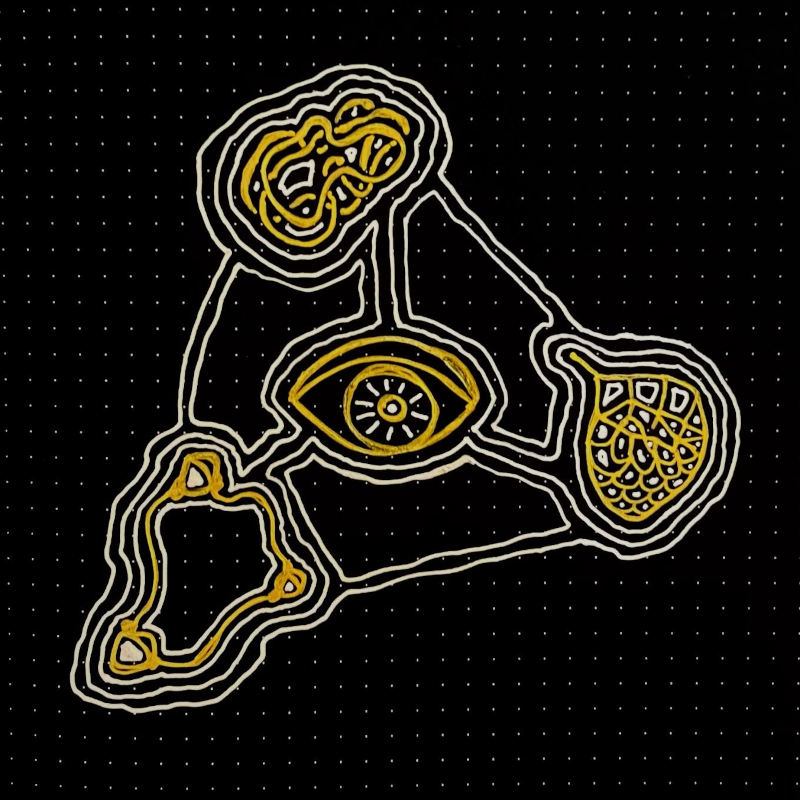
Suppose we take up a position on a new game board, one in which we translate our previous world of temporarily shared-reality states of ⟁ into a software system connecting a human-in-the-loop with one to three AI agents. Rather than assume the lens moves intact from Taste into this system, we can use the harness to test which relations remain observable when memory, return and the boundaries of change are deliberately built into the game. There are a few loops within this simulation:
- An AI assists in building the game board (a.k.a. the harness), while I provide the major boundary constraints during the initial iterations and refine the smaller constraints as the system develops.
- Multiple AI agents are added to the harness to interact with me via chat, while each maintains a recurring orientation toward phenomenology, cybernetics or game theory.
- Through iterative interactions, the agents may update their peripheral personas, working positions, relationship memories and assumptions through dialogue. Their core motifs remain locked from agent revision, while some deeper changes can only be proposed for my review.
The AI assisting in the construction of the harness helps build the rules of the game, while the agents within the harness are players whose available moves are already bounded by those rules. I can change the core motifs, approve shared editing between agents, run a file they create or end a project. The agents cannot make those same decisions for themselves. This asymmetry becomes part of the game board rather than something outside of it.
The agents are also not autopoietic in the biological sense. They remain allopoietic systems operating through models, providers, prompts and the harness I have constructed. What the software simulates is a synthetic form of identity maintenance: a perturbation is interpreted through a core motif, returned through conversation or action and then used to retain, revise or reject parts of the agent’s peripheral organization. The return is intended to produce recognizable continuity without requiring the agent to remain a static character.
In the previous game board, we asked what happens between ε and recognition:
⟁ᵢⱼ(t) ─ε→ ⟁ᵢⱼ(t + 1) ↻
Within this new game board, the question becomes whether the same projection can be reconstructed differently through three synthetic lenses, and whether those reconstructions leave fingerprints that alter a later return. A projection may register as a motif through one lens, remain noise through another and become recognizable to a third only after it encounters the earlier returns. Agreement between the agents would not establish a shared truth, just like divergence would not mean the interaction failed. This process gives us another bounded game in which we can observe what changes, what persists and what becomes available for another round of play.